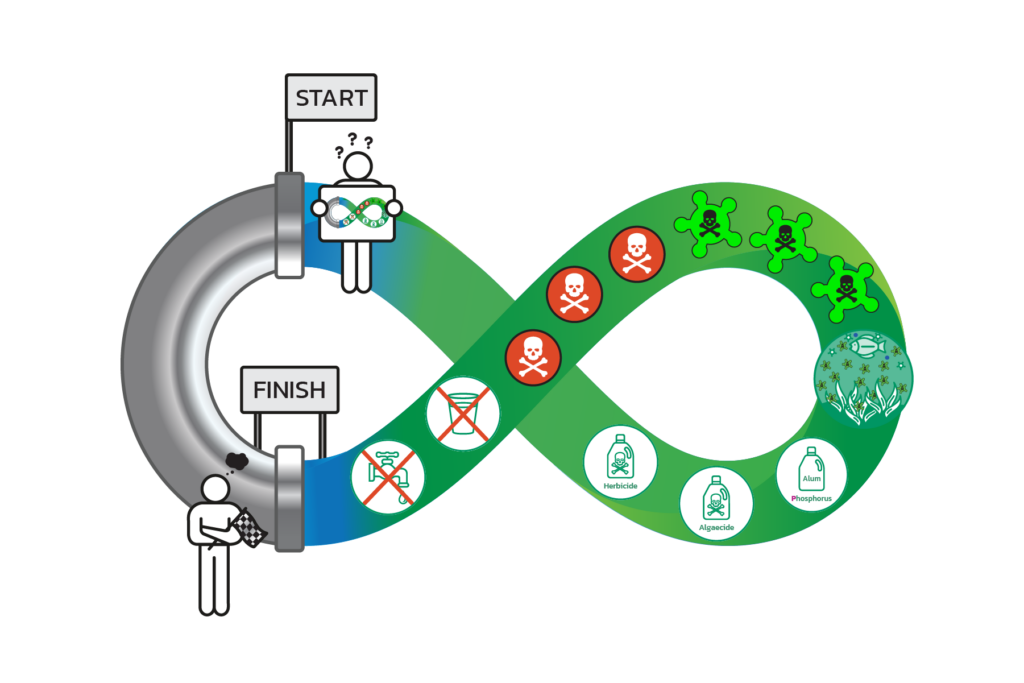
The intact blue loop represents natural water infrastructure functioning as a continuous, self-renewing cycle.

West Chester, PA Brisbane, QLD
The Natural water infrastructure that sustains Renewable water is being degraded by manmade water infrastructure – this is the Paradox of Infrastructure.
The infinite loop of the Renewable Water cycle is being progressively choked off.
Sustainable Water Security can only be found by following the

RESERVOIR RISK INDEX
R7.4 ▲ elevated
DISSOLVED OXYGEN
There’s only so much water on the planet for everyone to share
For millennia, Nature renewed water effortlessly, ensuring that rivers, lakes, and reservoirs remained vibrant, self-sustaining ecosystems. But today, more and more of our water is unusable.
This is not just another environmental issue – it is a crisis that threatens food security, economic stability, and public health worldwide because our natural water infrastructure is losing its ability to sustain Renewable Water.
The infinite loop of Renewable Water is being subverted. The Global Water Crisis is not about scarcity and quantity alone. It’s about quality and reusability.
The loop is more than a brand mark. It is the visual shorthand for Renewable Water: a natural cycle that can renew indefinitely — until manmade infrastructure overloads the natural infrastructure doing the real work.
01 · NATURE’S GIFT
The intact blue loop represents natural water infrastructure functioning as a continuous, self-renewing cycle.
02 · MANMADE INFRASTRUCTURE

The pipe shows engineered infrastructure connected to — and dependent on — the natural cycle rather than separate from it.
03 · ECOLOGICAL PRESSURE

The shift from blue toward green signals declining ecological function as nutrient, waste and treatment burdens drive eutrophication.
04 · THE PARADOX
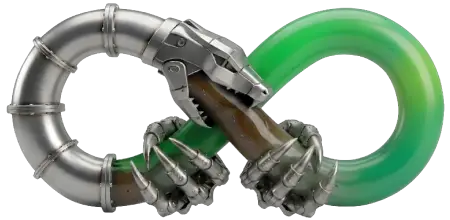
The destructive loop illustrates the paradox: adding more manmade infrastructure further degrades natural infrastructure – destroying the infinite loop of Renewable Water.


SIS.BIO applies a first-principles, Systems Theory approach to biological water and natural water infrastructure, treating wastewater treatment works, rivers, lakes, and reservoirs and as one continuous biological system rather than a series of disparate disconnected assets. Our work spans wastewater treatment, river remediation and eutrophic lake restoration across five continents, built on a single evidence base: nature already knows how to renew water. Our role is to restore its ability to do so.
If we keep doing what we have been doing, we will keep getting what we have been getting—only faster, at greater cost, and with less room to recover.
We are compounding the Paradox of Infrastructure with the Paradox of Symptomatic Treatments. Built systems continue to overload the natural water infrastructure that must renew water; then biocidal chemicals, phosphorus precipitants treat the visible symptoms while deepening the biological conditions that cause them.
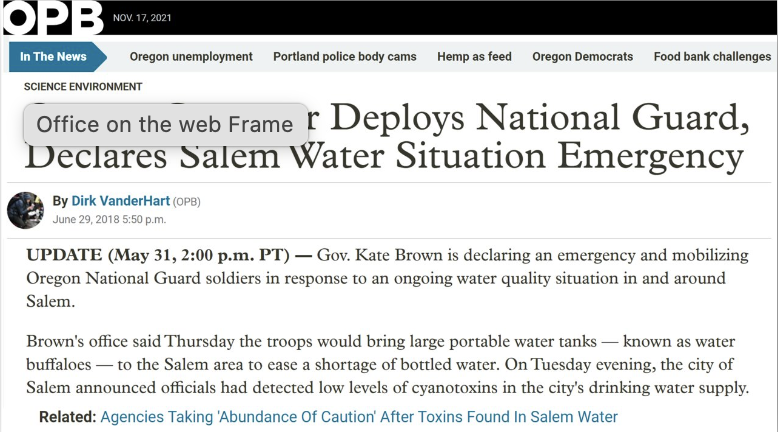
The destination is increasingly hard-to-treat water, treatment plants pushed beyond their design envelope, toxic untreatable water, supply shutoffs, and public-health crises. We have already seen glimpses of that future.
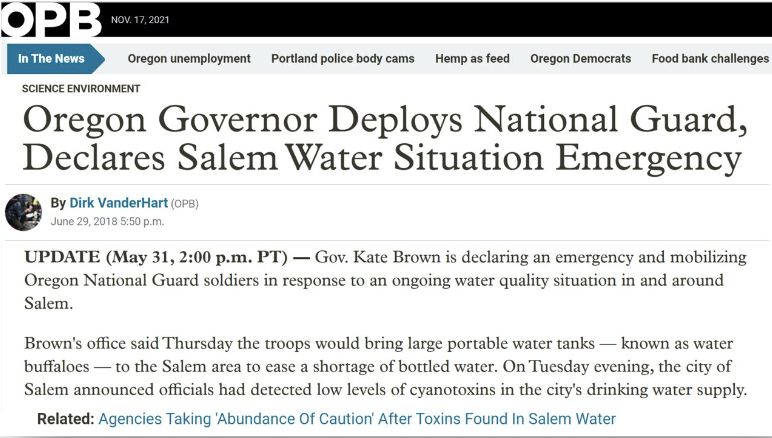
Natural infrastructure is part of water infrastructure.
No treatment plan can outrun deteriorating source water.
Water is secure only when it can be renewed for potable use.
A biological failure requires applied biology.
Symptom suppression is not restoration when it deepens biological debt.
Together, these five axioms explain why the present model is failing – and why water security can only be rebuilt around the restoration of biological function.
Five axioms · Six articles · One new agenda for water security
Water security cannot be achieved by treating water ever more intensively at the end of the pipe. It requires restoring the capacity of natural water infrastructure to renew water quality itself – repeatedly, reliably, and without accumulating biological or chemical debt.
The Road to Renewable Water leads to one integrated pathway to water security
The destination: water conitually and sustainably restored to a condition suitable for potable production, without accumulating biological or chemical debt.
The solution platform: applied biology that restores the oxygen, sediment, and food-web functions natural water infrastructure needs to renew water.
The measurement and performance-management framework: assessing biological condition at root-cause level, tracking progress over time, and verifying whether interventions are genuinely improving the system.
The game plan: a custom-developed route from current condition to measurable water security - for a single lake or reservoir, an entire watershed, or a regional water system.
Renewing natural water infrastructure is the only sustianable path to long-term water security.
Together, these components turn Renewable Water from an aspiration into a managed, measurable, and professionally accountable outcome.
Water security is changing in real time. A reservoir closure, a harmful algal bloom, a treatment failure, a new research finding, or a policy decision can expose a risk that conventional water management has not yet learned to see.
Perspectives on Renewable Water examines the developments shaping water policy, source-water risk, integrated water resource management, and applied biology – and tests them against the questions that matter most.
These are timely, evidence-led perspectives for the people who make water decisions. Each connects the story of the moment to the larger argument for Renewable Water – and opens a practical conversation about what credible action requires.
Research · Policy · Case studies · Informed opinion
Reactive water management — chemical dosing, emergency dredging, palliative treatment — produces a familiar curve: rising operating cost and declining ecological function. Every intervention treats a symptom, and every symptom returns.

Join us. The future of water is biological.
© Sustainable Infrastructure Solutions